








A specialty coffee roaster I read about launched a mobile app three years ago, mostly to handle loyalty points and pre-orders. Modest ambitions. The first year it was mostly a digital punch card. By the third year it had become the primary way they understood their customers — which roasts moved fastest in which neighborhoods, which customers were lapsing before they fully churned, which new products generated repeat purchases versus one-time curiosity buys. The app hadn’t changed dramatically. What changed was how much data they had about their own business, and how much better their decisions had gotten as a result.
Revenue per customer was up meaningfully compared to customers not using the app. Churn was measurably lower. Product development decisions that used to be gut calls were getting made from actual behavioral signals.
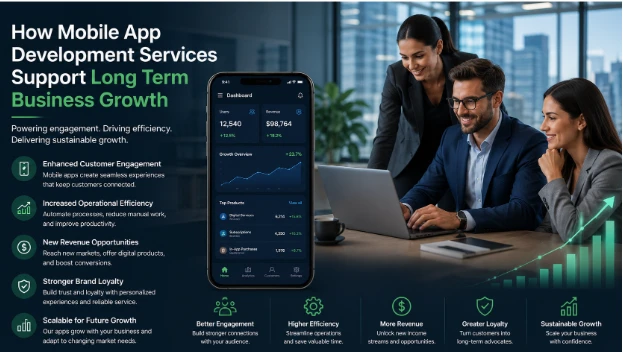
That’s the long-term case for a mobile app that rarely gets made clearly upfront. The immediate value — a direct channel, a loyalty mechanism, a better ordering experience — is visible and easy to pitch. The compounding value, what the asset becomes after two or three years of real usage data accumulating, is harder to articulate in a launch conversation and considerably more significant in practice. Good Mobile App Development Services understand this distinction, and the ones worth working with build toward the long-term asset, not just the near-term feature.
Here’s what that compounding actually looks like.
The Data Asset That Builds Over Time
A business without a mobile app knows what it sells and roughly how much. A business three years into a well-instrumented mobile app knows considerably more: who buys what, how often, in what context, after encountering which touchpoints, and how behavior shifts across time and seasons.
This isn’t abstract. It’s the difference between making product decisions by asking “what do we think customers want” and making them by observing what customers actually do. The gap between those two information states gets wider every year an app runs and accumulates behavioral data, which means the businesses that started building that data asset earlier hold a compounding advantage over ones that start later.
The specifics vary by industry. A retailer learns which product combinations predict high lifetime value customers versus one-time buyers. A service business learns which features correlate with customers who stay versus customers who churn quietly. A content platform learns which early engagement patterns predict long-term subscribers versus trial users who never convert. In every case, the insight is only available because the direct channel existed long enough to accumulate the signal.
Direct Channel Value That Compounds Differently Than Other Marketing
Customer acquisition gets expensive in every market that matures. Paid advertising costs rise as more competitors bid on the same audiences. Organic reach on third-party platforms erodes as algorithms shift. Email deliverability degrades as inboxes fill and spam filters tighten. Every borrowed channel tends to become more expensive and less effective over time.
A mobile app is a direct channel that the business owns. No platform algorithm between the business and the customer. No rising CPC as competitors multiply. The push notification that costs nothing to send at scale represents a form of customer reach that doesn’t inflate with market competition.
The businesses that built this channel several years ago and have been cultivating it since are now holding something genuinely valuable as paid channel costs have risen — a direct line to a large number of customers who opted in and who engage meaningfully. That asset was built incrementally, push notification by push notification, feature improvement by feature improvement, over years of consistent investment. It didn’t exist in year one and it can’t be replicated quickly by a late-moving competitor.
Why Invest in Custom Mobile App Development?
The answer that gets most scrutinized in boardrooms is the ROI calculation, and the honest answer is that the ROI from a mobile app investment typically looks modest in year one and increasingly compelling in years two and three, which is why the businesses that defund app investments after a modest first year often make an error that only becomes visible in retrospect.
Year one ROI from a mobile app is usually driven by direct revenue from in-app purchases or orders, and by cost savings from reducing friction in existing workflows. These numbers are real but tend to be conservative relative to the investment.
Year two and three ROI reflects what the data asset, the direct channel, and the operational efficiency gains are actually worth once they’ve had time to compound. Customer retention improvements from better engagement. Revenue per customer improvements from better product targeting. Acquisition cost improvements from referral features that only work once there’s an engaged base to refer from. Operational savings that accumulate as more customer interactions shift to self-service.
The businesses that evaluate mobile app ROI on a one-year horizon consistently undervalue the investment. The ones that model three-year outcomes and measure against them consistently find the investment performed better than it appeared to in year one.
Operational Leverage That Grows With the Business
A mobile app that handles customer self-service doesn’t just reduce support volume on day one. It does so increasingly as the customer base grows, because the ratio of self-service to staff-assisted interactions stays roughly constant while the absolute number of interactions scales. A business handling ten thousand customer contacts a month that could be self-served is saving different resources than one handling one hundred thousand.
This dynamic means the operational leverage of a well-built mobile app tends to become more significant, not less, as a business grows. The same investment that reduced support burden at a hundred thousand customers reduces it proportionally at a million — and by then the app infrastructure is already built.
The inverse is also true. A business that delays building this operational leverage until it reaches significant scale is building it when it’s most expensive to build and when the accumulated cost of not having it is highest. The businesses that built it early tend to arrive at scale with operational efficiencies that later-builders can’t replicate quickly.
The Competitive Moat That Accumulates Invisibly
Three years of behavioral data, a direct notification channel to an engaged customer base, and operational workflows that competitors without apps still handle manually — together these represent a competitive position that’s genuinely difficult to close quickly.
A competitor entering a market where an established player has three years of mobile app infrastructure and data accumulation faces a different challenge than one entering a market where everyone is starting from the same base. The established player’s advantage isn’t just the features in the app. It’s the institutional knowledge about customer behavior that shaped those features, the engaged user base that won’t immediately switch to an unfamiliar alternative, and the operational efficiency that lets the business run leaner than competitors without the same infrastructure.
This moat doesn’t look dramatic from the outside because it builds gradually and isn’t visible in any single product comparison. It shows up in retention metrics, customer acquisition cost over time, and the ability to respond to market shifts faster than competitors who are working from worse information about their own customers.
What Long-Term Thinking Looks Like at the Build Stage
All of this compounding value is only available to businesses that made certain decisions correctly at the build stage — decisions that look different when you’re thinking about year three than when you’re thinking about launch week.
Instrumentation that captures meaningful behavioral data from day one rather than being retrofitted after the business realizes it needs it. Architecture flexible enough to support features that don’t exist yet because the business isn’t large enough to need them yet. A direct notification channel built on genuine user consent and maintained through genuine value delivery rather than frequency. Operational integrations built on clean interfaces that can scale with the business rather than on shortcuts that need replacement once volume arrives.
None of these are expensive decisions relative to the value they generate over time. They’re just decisions that require thinking about what the app needs to become, not only what it needs to do at launch. That’s the distinction that determines whether a mobile investment becomes a long-term business asset or an expensive feature set that gets rebuilt every few years as it runs out of headroom.
The Coffee Roaster Three Years Later
Their app still looks roughly like it did at launch. The data underneath it doesn’t.
Three years of purchase behavior, product preferences, lapse patterns, and response to different promotions has made them considerably better at running a coffee business than they were when the app was a digital punch card. The product team makes decisions the marketing team used to make by instinct. The operations team sees demand patterns that used to only become visible after inventory problems had already happened.
The investment paid off in ways that weren’t fully visible in year one and are hard to overstate in year three. That’s not unusual. It’s the pattern for mobile app investments made with long-term outcomes in mind rather than short-term feature delivery.