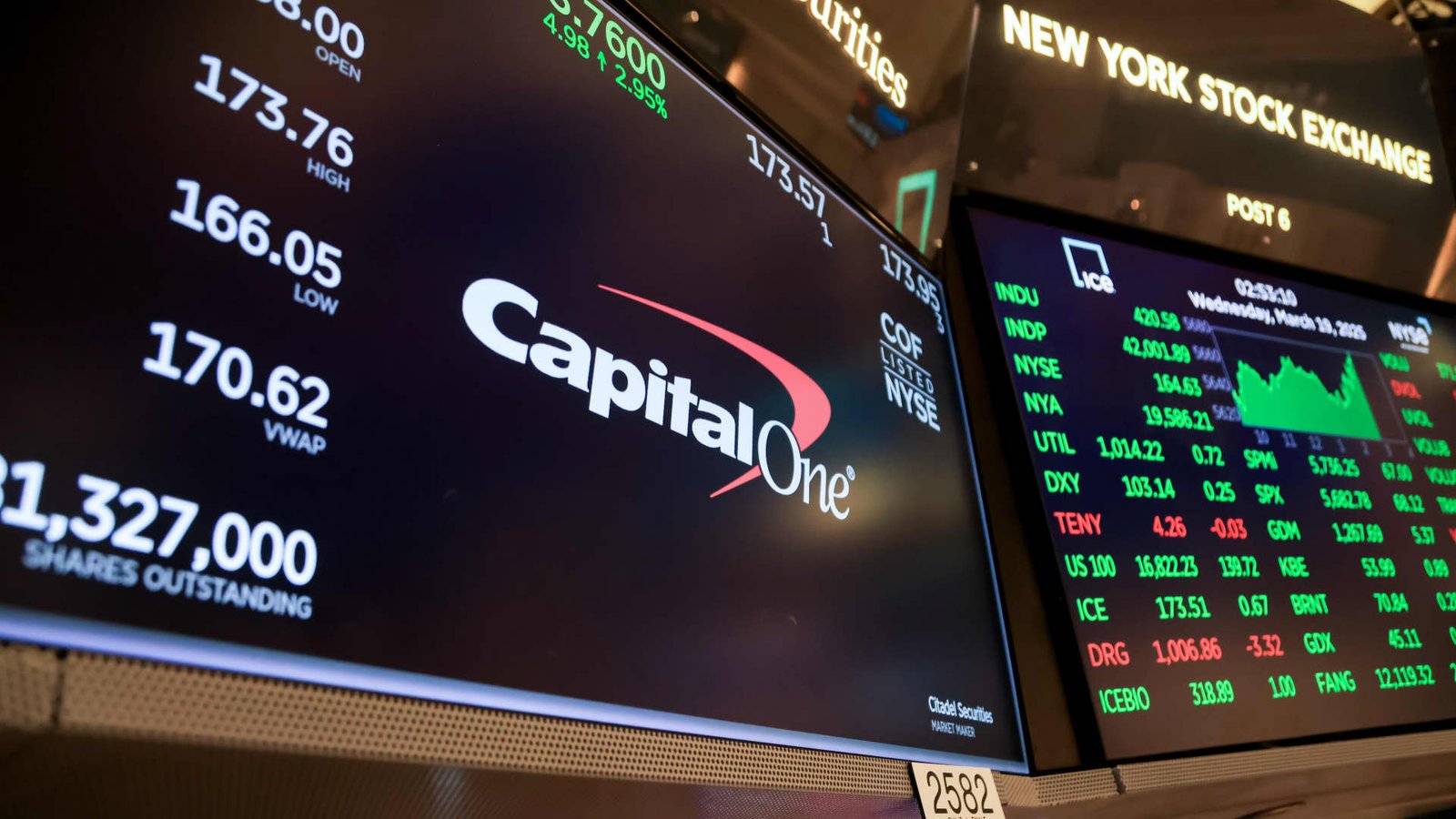








Capital One poured more than $35 billion into acquiring credit card rival Discover. After a couple of lackluster quarters and a slumping stock price, CEO Richard Fairbank must now prove to investors that the deal is the game-changer that was promised. The perfect stage to do that is Tuesday evening when Club name Capital One reports second-quarter results. The first earnings beat in the past two quarters would be a good start, considering higher-then-expected expenses have contributed to the back-to-back profit misses. In all, Capital One has racked up $1.8 billion in integration expenses incurred since the Discover deal closed last May, according to a securities filing for Q1 ended on March 31. To improve investor sentiment following its Q2 release and prevent a repeat of past post-earnings stock drops, management must do more than just account for its spending — it needs to connect the dots. Capital One needs to clearly outline how these deal expenses can accelerate its broader transformation with Discover now under its belt. The Street is looking for Capital One to report EPS of $4.75 on revenue of $15.77 billion in the second quarter, according to LSEG. It’s tough to compare year-over-year results due to the complexity of the Discover integration. But those estimates would be sequential improvements over the first quarter of 2026 and Q4 of 2025. During last week’s July Monthly Meeting, Jim Cramer said , “Fairbank has to explain why he made the acquisition. He has to rationalize the business.” Jim believes the CEO will do exactly that this quarter, giving the Capital One shares a chance over time to revisit their all-time highs of around $259 on Jan. 6. Trading around 9 times forward earnings, Jim said that Capital One is the “cheapest major bank in the country.” A complicating factor near-term is the stock’s 20% rally since hitting a 52-week low of just over $174 on June 11. We don’t like it when stocks spike ahead of earnings because it raises the bar on what investors are willing to pay for earnings. In this case, the bar here is still pretty low — and despite its quick five-week pop, shares would still need to jump some 24% to reach those record highs again. So, maybe that recent climb won’t be as much of a factor as it normally can be. COF 1Y mountain Capital One YTD Share price aside, Capital One needs to keep its eye on the ball and provide more visibility toward hitting its stated Discover deal goals of over 15% earnings per share (EPS) accretion and $2.7 billion in annual total synergies by 2027. Synergies are just a fancy way to describe the kind of value a company expects to be added from the deal. They include not just cost savings from layoffs, but also new revenue opportunities made possible by combining the businesses. Capital One insists those targets remain on track. Capital One was happy to add Discover’s massive credit card base, but Discover’s payment network was something it did not have, which put it at the mercy of Mastercard and Visa . Moving its cards over to the Discover network will allow Capital One to process its own transactions and to begin to save on the costly fees that Mastercard and Visa charge. Capital One has “substantially completed” the conversion of its debit cards to the Discover network, CFO Andrew Young said in April. Moving cards to the Discover network is “more of a next year thing,” Fairbank said. Owning the payments network makes Capital One more of a one-stop shop like American Express — though Capital One serves a wide income spectrum, while Amex’s clientele are more affluent. Capital One’s acquisition of corporate expense management platform Brex, which closed in April , also makes it look more like Amex. “The earnings performance has been a little bit mixed the last couple of quarters. Can they really start driving these cost synergies or at least tell that story?” according to Club portfolio director Jeff Marks. “So far, it’s been about investments and heavy investments to really take advantage of the Discover deal and building out that global network. So now as shareholders, we want to see the cost synergy side as well.” This is especially important because it’s the one variable Capital One can actually control, as a series of outside forces — including economic uncertainty and President Donald Trump ‘s policy threats — pressured the stock in 2026, which is still down 14% year to date. Back in January, the stock declined over 6% in a session after Trump called for a one-year, 10% cap on credit card rates. This would’ve put a huge dent in fees, which is the main way Capital One makes money. The president, however, never followed through on the proposal, which would have required congressional approval. Fast forward, and Capital One stock still hasn’t bounced fully back. Persistent inflation, elevated oil prices due to the Iran war, and speculation that the Federal Reserve’s next monetary policy move might be an interest rate hike have left investors cautious of pouring money into consumer-linked names like Capital One. While higher rates can benefit credit card companies on the revenue side, they can also increase defaults and lead to consumers spending less money. Worries have been heightened even more as the United States has become a “K-shaped economy,” Argus analyst Stephen Biggar said, meaning that wealthy households are thriving on rising asset values while persistent inflation on everyday essentials squeezes lower-income families. That puts Capital One more at risk as the company’s book has more exposure to subprime borrowers. “The K-shaped economy is resulting in some underperformance at the lower income level,” Biggar, who has a buy rating on shares, told CNBC in an interview. “Capital One is very exposed to this. [Credit cards] are basically 70% of their business, and so that has caused some concerns about the stock.” The analyst also pointed to Capital One’s “fairly large” reserve build last quarter. That’s money set aside to cover potential future losses. He said the market might have viewed that as a negative because it highlighted “that they expect some weakness or deterioration in credit quality.” Hopefully, Capital One won’t need those reserves, as the major banks that have reported earnings thus far have not cited consumer health as a big concern. Wells Fargo CEO Charlie Scharf said during its latest post-earnings call: “Consumer spending is higher, charge-offs are lower, and savings investments are growing across customer segments. Businesses are cautious, but balance sheets and cash flows remain strong, resulting in strong credit performance. Scharf added: “Concerns around affordability and inflation exist, but the labor market and wage growth remain strong. The markets and U.S. economy have absorbed macroeconomic and geopolitical uncertainty well.” Scharf’s views on consumer behavior are especially important and relevant to reading the tea leaves on what Capital One may report. Wells Fargo, also a Club name, has a huge consumer banking and lending business, with credit cards emerging as a growth opportunity for the bank. It reported a 46% year-over-year increase in new credit card accounts during the second quarter. (Jim Cramer’s Charitable Trust is long COF, WFC. See here for a full list of the stocks.) As a subscriber to the CNBC Investing Club with Jim Cramer, you will receive a trade alert before Jim makes a trade. Jim waits 45 minutes after sending a trade alert before buying or selling a stock in his charitable trust’s portfolio. If Jim has talked about a stock on CNBC TV, he waits 72 hours after issuing the trade alert before executing the trade. THE ABOVE INVESTING CLUB INFORMATION IS SUBJECT TO OUR TERMS AND CONDITIONS AND PRIVACY POLICY , TOGETHER WITH OUR DISCLAIMER . NO FIDUCIARY OBLIGATION OR DUTY EXISTS, OR IS CREATED, BY VIRTUE OF YOUR RECEIPT OF ANY INFORMATION PROVIDED IN CONNECTION WITH THE INVESTING CLUB. NO SPECIFIC OUTCOME OR PROFIT IS GUARANTEED.
Capital One bet big on Discover. Now it must prove the gamble was worth it