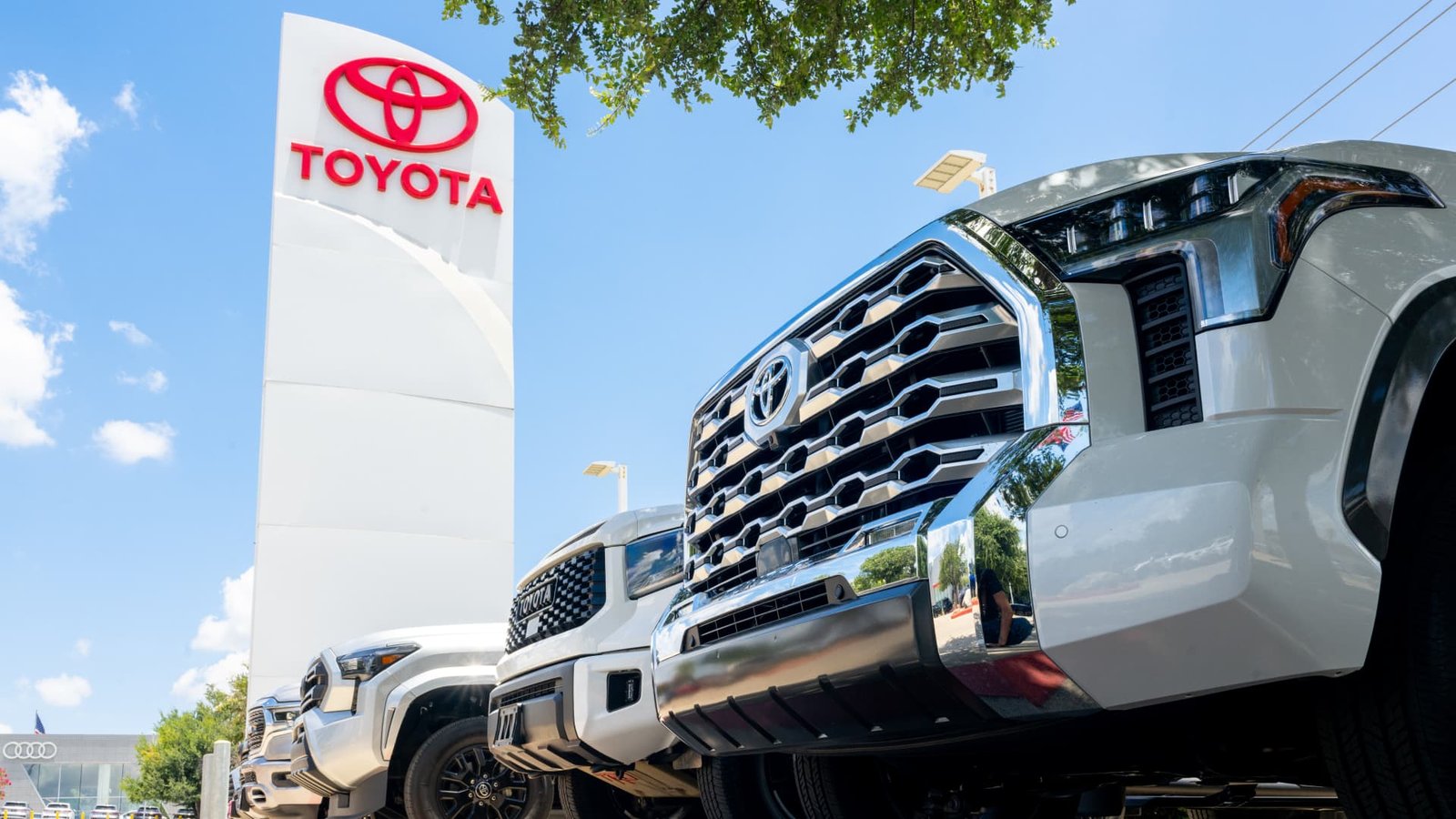









Toyota Motor is beginning to look like a classic seller-exhaustion reversal after a 30% decline from its prior highs. The stock has spent the past several months grinding lower, but recent price action suggests that downside momentum may be fading. TM has now reclaimed an important resistance level and crossed back above its 50-day moving average, creating an early signal that the trend may be shifting from distribution to accumulation. That technical improvement is being supported by a much stronger fundamental story than the chart is implying. Toyota remains the world’s largest automaker by volume, with roughly 9.6 million vehicles sold in FY26, and boasts a fortress balance sheet and a dominant hybrid fleet at the same time as consumers are pushing back against pure electric vehicles. The company’s electrified powertrain mix now makes up over half of all sales, led by hybrids and plug-in hybrids. What makes the setup especially compelling is the combination of valuations and capital return. Toyota recently launched a $25 billion, tender-offer buyback that retires about 7% of outstanding shares, one of the largest repurchases in Japanese history. Combined with a strong dividend and a balance sheet with $50 billion in cash, TM offers an unusually attractive mix of value, quality and upside potential. Trade Timing & Outlook TM recently reclaimed the $180 breakout level after showing signs of seller exhaustion near the lows. Bottoming: The stock appears to be stabilizing after a multi-month decline, with recent inverse head and shoulders pattern suggesting sellers may be running out of momentum. Breakout Level: A sustained move above $180 confirms the early reversal and turns that level into near-term support. Upside Target: If the breakout holds, the next major upside objective is $200 initially, with a longer-term recovery target toward $235 if momentum broadens. Fundamentals Toyota trades at a valuation that remains attractive relative to its scale, balance sheet, and earnings quality. Toyota trades only modestly above the peers, but that premium is justified by stronger margins, superior scale and a massive buyback program. The stock also trades near book value despite a roughly 10% return on equity, which creates room for a re-rating if investors begin to value Toyota as a leader rather than a legacy automaker. Bullish Thesis Hybrid Leadership: Toyota’s hybrid-first strategy is increasingly being validated as consumers push back against the cost, charging limitations and adoption curve of pure EVs. Capital Returns: The $25 billion buyback, retiring 7.6% of shares, provides an immediate EPS tailwind and signals management’s confidence in the value of the stock. Easing Tariff and Currency Overhangs: The July 2026 U.S.-Japan trade deal reduced Japan auto tariffs from 25% to 15%, helping relieve one of the major earnings headwinds from FY26. Valuation Leaves Room for Re-Rating: Toyota is priced like a cyclical automaker despite having stronger margins, a cleaner balance sheet and a more defensible powertrain strategy than many peers. Options Trade To express a bullish view with defined risk, I’m buying the Sept. 18, 2026 $180/$200 Call Vertical @ $6.20 debit. This entails: Buying the Sept. 18, 2026 $180 Call Selling the Sept. 18, 2026 $200 Call Maximum Risk: $620 per contract if TM is below $180 at expiration Maximum Reward: $1,380 per contract if TM is at or above $200 at expiration Breakeven: $186.20 This structure targets the first leg of the recovery toward $200 while keeping downside risk defined if the breakout fails. View this Trade on OptionsPlay for Updated Pricing Summary Toyota is no longer just a legacy auto stock, it is now a global leader in hybrids at a time when consumers are increasingly choosing practical electrification over pure EVs. The stock’s recent reclaim of $180, combined with a massive buyback, a strong balance sheet and improving tariff dynamics, creates a compelling setup. For investors seeking defined-risk exposure to a potential auto recovery, TM offers an attractive combination of technical reversal and capital return. DISCLOSURES: None All opinions expressed by the CNBC Pro contributors are solely their opinions and do not reflect the opinions of CNBC, or its parent company or affiliates, and may have been previously disseminated by them on television, radio, internet or another medium. THE ABOVE CONTENT IS SUBJECT TO OUR TERMS AND CONDITIONS AND PRIVACY POLICY . THIS CONTENT IS PROVIDED FOR INFORMATIONAL PURPOSES ONLY AND DOES NOT CONSTITUTE FINANCIAL, INVESTMENT, TAX OR LEGAL ADVICE OR A RECOMMENDATION TO BUY ANY SECURITY OR OTHER FINANCIAL ASSET. THE CONTENT IS GENERAL IN NATURE AND DOES NOT REFLECT ANY INDIVIDUAL’S UNIQUE PERSONAL CIRCUMSTANCES. THE ABOVE CONTENT MIGHT NOT BE SUITABLE FOR YOUR PARTICULAR CIRCUMSTANCES. BEFORE MAKING ANY FINANCIAL DECISIONS, YOU SHOULD STRONGLY CONSIDER SEEKING ADVICE FROM YOUR OWN FINANCIAL OR INVESTMENT ADVISOR. Click here for the full disclaimer.
Here’s an options trade to limit risk and capture potential returns in Toyota