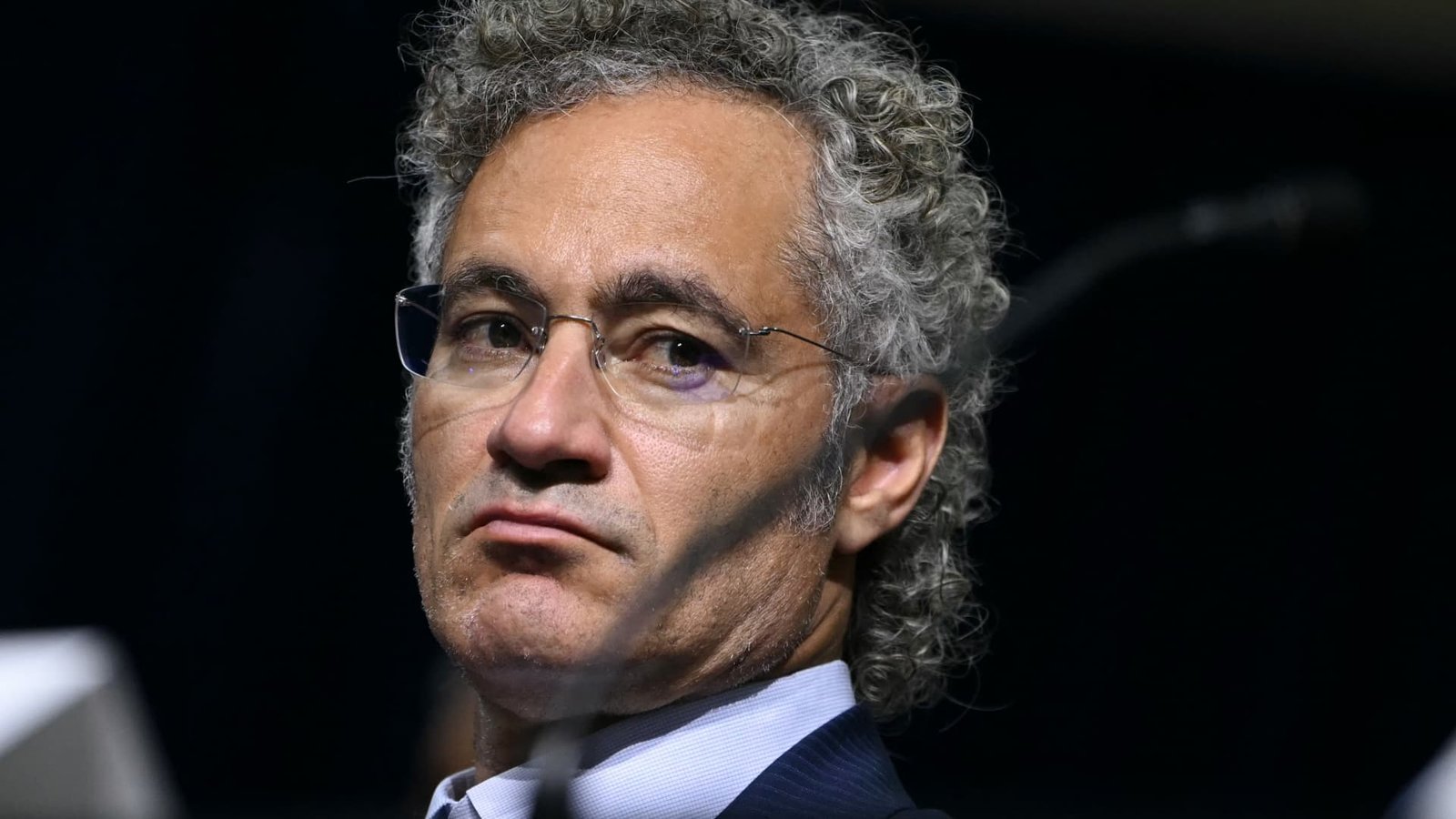









Military software company Palantir was supposed to be the stock for the current geopolitical moment, but its poor performance over the past year speaks to deeper disruptions happening in technology as a result of artificial intelligence. The iShares IGV tech software ETF is down about 14% since the beginning of the year, but Palantir – the third largest weighting in that ETF – has suffered more, sliding nearly 33% in the same period. Like the rest of the software business, Palantir has been facing a general threat from AI that has weighed on valuations across the sector. The company, led by CEO Alex Karp, has also had some sky-high expectations to live up to, including triple-digit price-to-earnings and enterprise value-to-sales multiples over the past several quarters, both of which are now trending down. But the real problem with the stock, analysts say, is fear about AI’s increasing ability to handle the data-heavy workloads that Palantir specializes in. PLTR YTD mountain PLTR year to date. Looming specter “I think there is this specter hanging out in the future of Anthropic being able to do everything or OpenAI being able to do everything,” John McPeake, senior research analyst at Rosenblatt, told CNBC on Friday. “It’s having [someone] say, ‘Create me a Palantir,’ and it’ll magically appear. That’s not too much of an exaggeration. These large language models are perceived as code generators that can do anything. That’s kind of weighing on them.” Anthropic put out a blog post earlier this month about its improving data analytics capabilities that “doesn’t sound great” for software companies like Palantir and Snowflake , analysts at UBS said in a mid-June note to clients. Karl Keirstead at UBS noted “rising investor concern” about Anthropic and OpenAI’s data workload capabilities as well their ability to turn those powers into a commercial product. There’s “concern … that Anthropic and OpenAI will productize these features and launch [first-person] products that customers can use in lieu of spending on Palantir,” he wrote. Potential overlap Palantir partner company Snowflake, which offers data management services used by Palantir’s operating system, conceded earlier this month that there could be “overlap” between what the frontier AI models do and what the data specialists do. “In many ways, I am seeing the dynamics with the AI model providers similar to what has happened with the cloud providers where, yeah, there may be some overlap,” Christian Kleinerman, Snowflake’s head of product, said at a June 2 investor day. “We’re more complementary than not at many customer sites, and so far it seems to be very similar dynamics.” Palantir’s customers are acknowledging this overlap with frontier AI on products like data mapping and graphing and are moving to take advantage of it. “I’d like to explore building a parallel open source graph database or using OpenAI and Anthropic,” one Palantir customer said at the company’s AIPCon 10 conference in San Francisco in early-June, according to a recent UBS note. “I’m not sure if these will deliver the same outcomes but I hope they will. It would be great to have them come in and drop a package that we can use. We want to be open, but Palantir is not open.” Karp, Palantir’s CEO, has pushed back hard against the capacity of large language models to replicate Palantir’s product at the commercial level, calling it a “farce.” “You get to [statements like] ‘We’re going to replicate Palantir by doing a deploy code.’ I mean it’s a complete farce,” Karp told CNBC in early June. “It is not that large language models aren’t crucial for the world; it’s just the implementation is where the value is.” But investors aren’t waiting around, picking up on potential redundancies and resulting frustrations and making moves on them. Hedge fund manager Michael Burry, for example, is shorting the company and covering his past positions. “I covered half of my Palantir (PLTR) short at $107.15. I continue to hold puts,” he wrote in a June 25 post on Substack . More positively, other investors see Palantir benefiting from the continued AI infrastructure buildout, which they expect to result in more proven revenue and monetization trends in coming quarters. “The market is way mispricing what this demand trend is going to look like over the next six to nine months, what the monetization trends will look like on enterprise, and that goes from Microsoft to Oracle … and even some of the software names like Palantir,” Dan Ives, head of technology research at Wedbush, told CNBC on Friday.
What’s wrong with Palantir? How investors see the stock